Power and cooling
Grid first. Hybrid in phases.
The initial B300 deployment is planned to start on OG&E grid power. The campus concept places direct-liquid-cooled compute in Buildings A and C, with the chiller yard behind B. Solar and battery energy storage (BESS) follow as a separate investment; equipment and power allocations require engineering and commissioning.
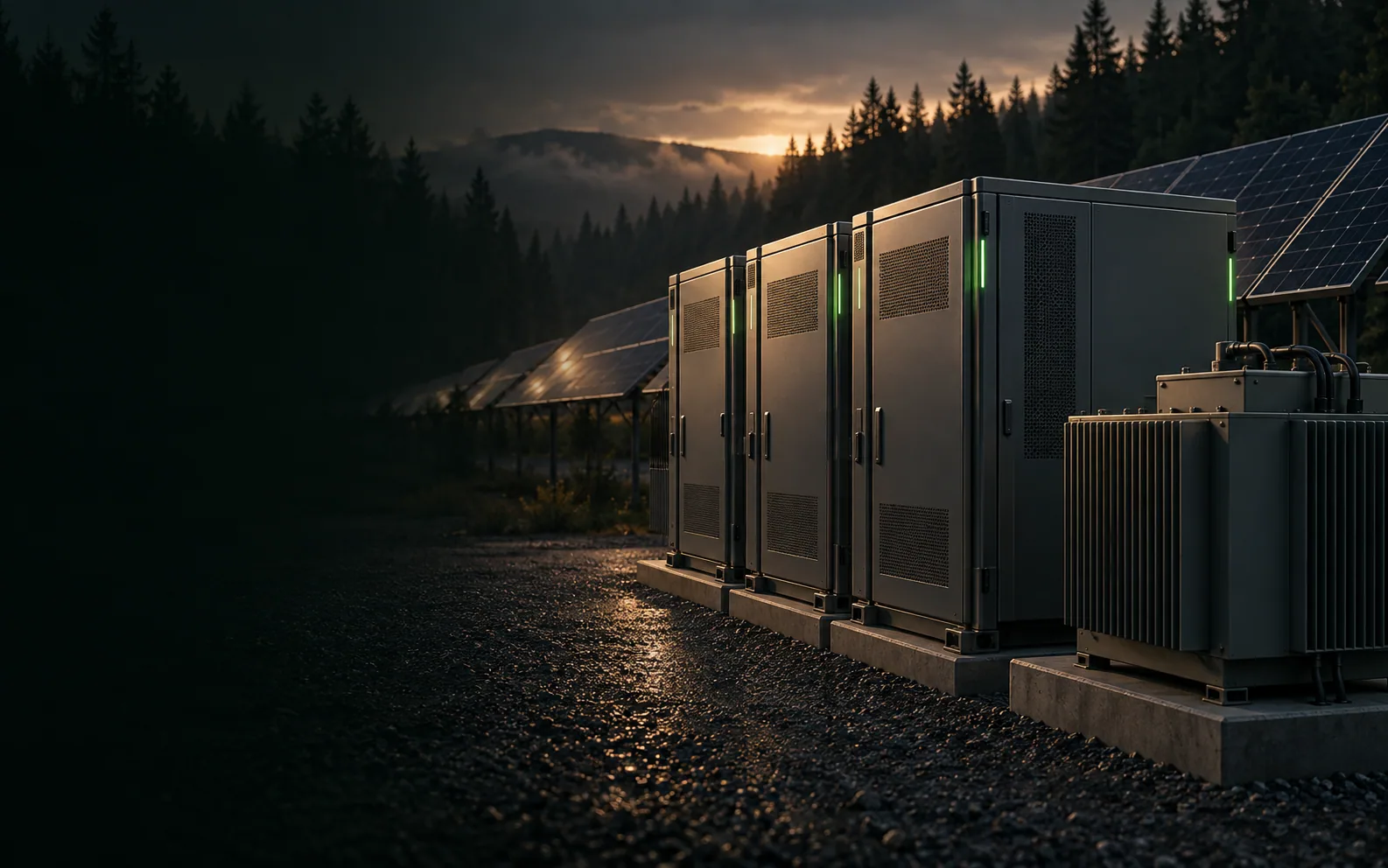
The initial deployment is planned on grid power. Solar and BESS are a separate later investment; tariff, demand charges and utility allocation require confirmation.
A shared 3,000 A, 208 V three-phase service is reported on site. OG&E commissioning is targeted for 8 October 2026; this is not exclusive IT capacity.
The approved campus concept uses direct liquid cooling and separate facility/server-coolant loops. The 14 September management target · v6.1.1 cost basis workbook remains an air-cooled, one-building financial baseline; exact direct-liquid equipment, voltage, installed scope and performance require engineering and repricing.
Follow the energy story.
AI energy concept · Flow and lighting are illustrative, not live telemetry.
Choose a topic, or open the 3D model.
Scene controls
Illustrative future hybrid-energy scene. Launch is planned on grid power; solar and BESS are a separate later phase. Equipment shown does not establish installed capacity or backup duration.
Transformer on site. Commissioning ahead.
Management reports an on-site transformer and shared distribution for Buildings A, B and C, with utility commissioning ahead. Buildings A and C provide 5,035 gross sq ft for data-center development; Building B supports batteries, utilities and storage.
UDGOK is the construction contractor, with a 24 September 2026 target. The electrical commissioning milestone is an 8 October 2026 target. These management targets are part of the development schedule; customer service begins after equipment, cooling and connectivity are ready.
- Serving utility
- OG&E
- Reported shared service
- 3,000 A at 208 V, three-phaseOne rating across Buildings A, B and C. Transformer nameplate and usable IT allocation require verification.
- Apparent service rating
- Approximately 1,081 kVACalculated from stated voltage and current. This is not an available IT allocation.
- House / office
- 200 A, separateSeparate from the data-center building allocation.
Capacity for your deployment. Each proposed allocation will be assessed against the electrical design, cooling system and accepted operating limits. Share your IT load and redundancy requirements to start that review.
Build the first phase around the grid.
The initial deployment is planned to run on grid power. The utility tariff, demand charges, continuous allocation and commissioning must be confirmed for the approved IT and cooling load.
Solar and BESS are a separate later investment, to be installed in phases after launch as the hybrid design and economics are validated. The initial operating case does not depend on solar savings or battery dispatch. Any future gas-generation proposal will need its own fuel, maintenance, emissions, interconnection and reliability review.
- Initial energy source
- Grid power first
- Grid commercial terms
- Utility confirmation requiredEnergy, demand charges and any minimum billing requirements belong in the complete tariff review.
- Continuous IT allocation
- Engineering and utility reviewA shared service rating does not establish exclusive continuous IT capacity.
- Later hybrid phase
- Solar and BESSSeparate capital, approvals and commissioning; savings and backup performance require validation.
Direct liquid cooling. Separate water circuits.
The campus concept uses direct liquid cooling for B300 systems in Buildings A and C, with a proposed chiller yard behind B. The owner specifies a closed-loop Daikin plant at 208V; the exact model and compatible operating conditions remain to be confirmed.
Facility water carries heat from the coolant distribution units (CDUs) to the outdoor plant. Inside each CDU, a heat exchanger keeps facility water separate from the server-coolant circuit.
Overhead supply and return pipes carry server coolant to rack manifolds and B300 cold plates. Room cooling still handles residual heat and humidity. The routing study includes service access, isolation and leak detection; final equipment and installation details require engineering.
- Compute layout
- Buildings A and CFour systems in A and four in C are illustrated; final allocation and measured fit-out remain subject to design.
- Heat rejection
- Proposed yard behind BClosed-loop Daikin at 208V is the owner’s intent. Exact model, voltage compatibility and operating temperatures remain to be confirmed.
- Server cooling
- CDU → overhead headers → rack manifoldsSupply and return form a separate server-coolant circuit; facility water does not feed the cold plates directly.
- Complete design
- Supplier and engineering reviewThe server SKU, CDU and facility-water circuits, residual room cooling, local-weather duty, voltage compatibility and complete installed cost require supplier quotes and engineering acceptance.
Published model 14 September management target · v6.1.1 cost basis retains an air-cooled, one-building financial baseline. The approved campus experience illustrates a proposed direct-liquid design across Buildings A and C; it requires updated equipment quotes, engineering and repricing before it is included financially.
Add solar and storage as the campus develops.
Tract 3 is the planned area for later solar development, with future BESS shown inside Building B. The 18.20-acre tract planning estimate is not a buildable-area survey. Generation capacity will follow site layout, electrical design, permitting and utility approval.
Z1Power, the parent battery producer, connects the campus strategy with energy-storage development. SmartTec.dev LLC operates under SmartTec Holdings LLC, bringing data-center operations into that wider platform.
Solar and storage are a later development phase. Equipment sizing, interval-load analysis, tariff treatment, battery losses and replacement costs will establish their investment case. Utility approval and commissioning will establish their contribution to the campus.
The concept connects future BESS through a power conversion system (PCS) at the common distribution bus, on a branch separate from the IT UPS. This arrangement does not establish backup duration or islanding capability.
Three connected uses
- Buildings A and C: compute and colocation.
- Building B: future BESS, utilities and storage.
- Tract 3: planned solar development.
Plan the load, cooling and service together.
A deployment proposal brings together IT power, cooling, metering, support and commercial terms. Include your uptime and compliance requirements so they can be assessed before an offer. No commissioned capacity or uptime guarantee is advertised at this development stage.